
Image source: Freepik
Traditional SEO has long focused on high-volume keywords, rankings, and technical checklists. Those fundamentals still matter. Search behavior, however, has changed.
People no longer search with single broad short-tail phrases like “running shoes”. They search with intent layered into long-tail queries. For instance,
- Best running shoes for flat feet
- How to break in running shoes
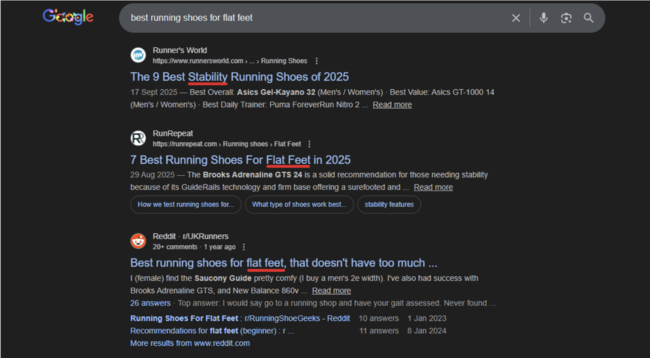
Screenshot provided by author
Each modifier signals a specific problem, concern, or decision stage. That signal often exists only for a short window, but when captured early, it creates a clear path to conversion.
However, most traditional SEO models miss this. Keywords are grouped into large buckets, and single pages are expected to satisfy multiple intents at once. The result is content that ranks but rarely converts well.
Micro-intent SEO flips that approach.
Rather than chasing broad topics, it focuses on identifying and serving the exact motivation behind a search. That means paying attention to attributes, comparisons, anxieties, and constraints hidden within long-tail queries.
Once those signals are mapped, guiding users to the next step toward sales becomes straightforward because the content aligns with their current moment.
In this article, we’ll explain what micro-intent SEO is all about and how to use it to drive sales in 2026.
What is micro intent in SEO?
Micro intent is the specific action a searcher wants to take at that exact moment, revealed through the modifiers they use in a query.
Now, this is different from broad intent labels like informational, navigational, or transactional, which only describe the category of a search. Micro intent goes a step further by explaining the decision stage, constraints, or concerns within that category.
For example:
- “X pricing” signals a broad commercial intent. It indicates the buyer has moved past the consideration stage into the decision-making and purchasing stages. However, the query does not provide insight into the financial situation of the buyer
- Whereas “X Pricing for nonprofits” signals a more niche commercial intent, shaped by budget constraints, eligibility requirements, and expectations for discounts. The buyer indicates “non-profit” so that you can bring up pricing options within the capacity of an organization, not income-tied
As such, the content, CTA, and conversion path for both queries cannot be the same.
Micro-intents appear everywhere:
- Informational: how-to, troubleshooting, or compatibility
- Evaluational: vs, alternatives, or asking if it is safe
- Transactional: near me, free trial, or in stock
- Post-purchase: setup, integration, or warranty
Why is this important in SEO and for sales?
First, long-tail, intent-driven keywords identified in keyword research often reveal more micro-intents than short-tail keywords. And that explains why they generally convert more than one or two-word keywords.
According to Ranktracker, the rate is roughly 2.5x higher than for short-tail keywords, often reaching an average conversion rate of 36%.
Second, high keyword conversion means more relevant clicks to your page because you create content that addresses audience needs at the right time. Buyers commit faster when brands answer specific questions tied to their immediate pain points, which boosts trust and loyalty.
Potential customers who trust you convert faster.
How to boost sales using micro-intent
Using micro-intent to grow your sales is not rocket science. Let’s break down the four steps to do that.
1. Identify the subtle search cues
Subtle search cues hide in long-tail variations, in-site search logs, and People Also Ask questions. Key hunting grounds include:
- Attributes or constraints: lightweight, under 50 dollars, or HIPAA compliant.
- Comparison language: vs, alternatives, or better than.
- Risk and reassurance terms: secure, return policy, or data retention.
- Contextual clues: for beginners, for Shopify, or carry-on only.
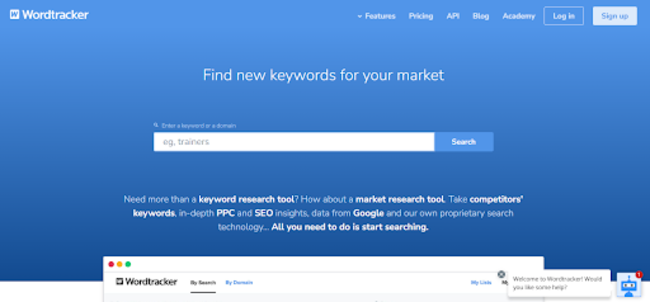
To find these, use Google Search Console query data with regular expression (regex) filters to catch clusters. Use tools like Wordtracker to identify and filter by modifiers like “for” or “vs”.
2. Turn those cues into valuable pages and content
Google’s research on the Messy Middle shows that brands that provide specific, authoritative content during the evaluation phase can capture up to 43% of the preference share. Finding micro-intents is only the first step. You must meet them with content and UX that moves people forward.
Tactics that work:
- Answer precisely: If someone searches for a specific solution, lead with that exact answer and show proof.
- Build comparison pages: Cover real use cases and make next steps clear.
- Create intent-specific components: Use checklists for readiness or calculators for costs.
- Match CTAs to intent: Use Compare models for evaluators and Check availability for transactional searchers.
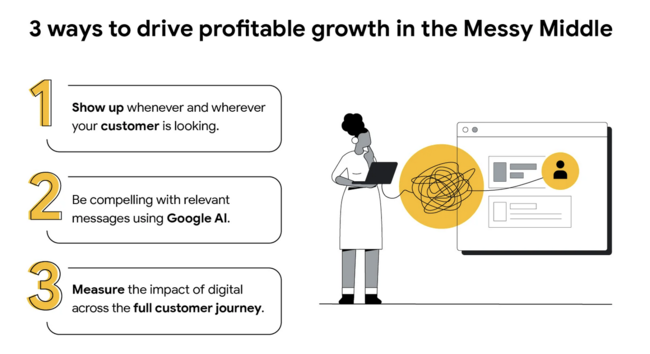
Image source: Google Think
AI usage by enterprises for content production keeps scaling, but output alone does not create results. Beyond just pushing out dozens of pieces of content every time, it’s vital to ensure they focus on the cues and address customer-centric pain points.
3. Implement a micro-intent workflow
Most businesses fail because they treat micro-intent as a one-off task rather than as part of a content architecture. To move from theory to execution, you need a functional, continuously running micro-intent engine. Follow these steps to build one.
Phase 1: Find the modifiers
Start by identifying the modifiers that signal high intent in your industry. You are not looking for keywords yet. You are looking for the exact grammar that describes your customer's problems.
- Extract site search data: Go to your Google Analytics 4 (GA4) account and look at the terms people type into your own search bar. These are often high-anxiety queries like "how to return" or "compatible with iPhone 15".
- The problem audit: Interview your sales and customer support teams. Ask them: "What is the one specific question people ask right before they sign the contract or hit buy?" Often, it is a micro-intent regarding security, implementation, or specific use cases.
- Use regex for discovery: In Google Search Console, go to Search Results > Queries and apply a Custom (regex) filter: \b(how|why|vs|best|alternative|review|can|does|is)\b. This will isolate the micro-intents from your broad brand traffic.
Phase 2: Map the content format
Once you have a list of micro-intent queries, you must match the searcher's mental model with the correct content format.
- Comparison queries (product vs. product): Create a side-by-side table. Do not just write paragraphs. Users in this stage want to scan for differences in price, features, and limitations.
- Constraint queries (under $X or for beginners): Use a curated list format. Lead with the "Best Overall" pick to reduce decision fatigue.
- Anxiety queries (Is it safe? or Return policy): These require a "Reassurance Module". This is a high-visibility block of text or a graphic that displays trust signals, certifications, and clear, plain-English policies.
Phase 3: Use flexible CTA architecture
The biggest mistake in micro-intent SEO is using the same "Book a Demo" or "Buy Now" button on every page. To convert, the CTA must align with the specific micro-intent.
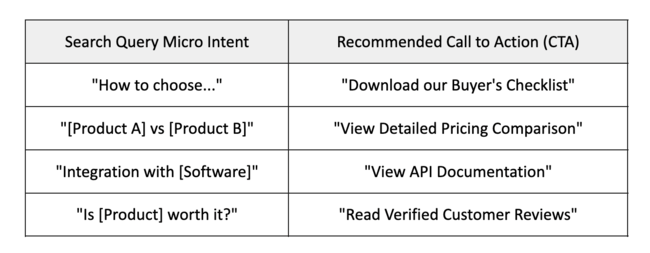
Phase 4: Measure assisted value
Micro-intent pages often do not receive the credit they deserve because they are in the middle of the funnel. A user might visit your "Product A vs Product B" page, leave, and return three days later via a direct search to make a purchase.
Use the Path Explorations tool in GA4 to see how these specific pages contribute to the final conversion. If a page has a low direct conversion rate but appears in 40% of successful purchase paths, it is a high-value micro-intent asset.
4. Leverage SEO tools for micro-intent analysis
You do not need every tool available; a tight stack and good habits win. Use Wordtracker to build intent lists, such as comparison or post-purchase, and to check SERPs to see what content formats rank. If Google shows calculators or docs, that format fits the intent.
Run key pages through a free SEO checker to identify gaps where search intent exists, but answers are incomplete, unclear, or misaligned with user expectations, before taking action. Wordtracker's domain tool can also be helpful in showing which keywords are driving clicks to your competitors' websites.
Micro-intent SEO is also a speed strategy. Data indicates that pages optimized for long-tail keywords move up within the first few months, nearly twice as fast as those targeting short-tail terms.
So, use your tools to collate your intent-centric long-tail keywords and use them to update as many key pages as you have to rank.
3 brands using micro-intent to drive sales
Brands like REI, River Pools, and Zapier already implement micro-intent SEO. Here’s what they did.
- REI expert advice
REI publishes detailed guides that answer specific questions, such as how to choose hiking boots or how to size a backpack. These pages target narrow search intents and naturally lead readers to relevant product categories without forcing a sale.
- River Pools and Spas
River Pools built content that directly addresses buyer comparison questions, such as fiberglass vs. concrete pools and cost-related concerns. By addressing these high-intent queries transparently, the company attracted qualified traffic and generated consistent sales leads even when buyer hesitation was high.
- Zapier integrations pages
Zapier created hundreds of pages on specific app-to-app integrations, such as Slack-to-Google Sheets. Each page addresses a specific workflow challenge, making the content highly intent-matched and conversion-focused.
Wrapping up
Micro-intent SEO is about listening closely. Those small modifiers and questions tell you exactly what someone needs. Answer precisely, match the correct format, and make the next step easy. This turns rankings into revenue by publishing the content that matters at that moment.
The subtle search cues are already in your data. Your customers are telling you exactly what they need to hear before they trust you with their money. The important thing is to build the pages to answer them.